
MDR · IVDR · Annex VI
Basic UDI-DI under MDR and IVDR
One regulatory identifier connects a defined device model group with EUDAMED, certificates, declarations and technical documentation. It is not the barcode on the label and it is not assigned to each package.
The regulatory concept
A model-level key, not a label identifier
Annex VI defines the Basic UDI-DI as the primary identifier of a device model. MDCG 2018-1 Rev.4 explains that it connects devices sharing the same intended purpose, risk class and essential design and manufacturing characteristics.
Basic UDI-DI
Groups the related devices and provides the common regulatory key. It is independent of packaging and labelling.
Documentation · certificates · EUDAMEDUDI-DI
Identifies a specific device version or model and, where applicable, each higher packaging level other than shipping containers.
Device identity · package configuration · database recordUDI-PI
Carries production information such as lot, serial number, manufacturing date, expiry date or software identification when applicable.
Production control · traceability · field actionThe UDI carrier contains the UDI-DI and the applicable UDI-PI in automatic identification and human-readable form. The Basic UDI-DI does not appear on the trade item.
These are the standard rules for devices subject to the UDI system. MDR custom-made devices are excluded from UDI assignment, while legacy devices use the separate identifiers and registration rules defined for EUDAMED.
Product grouping
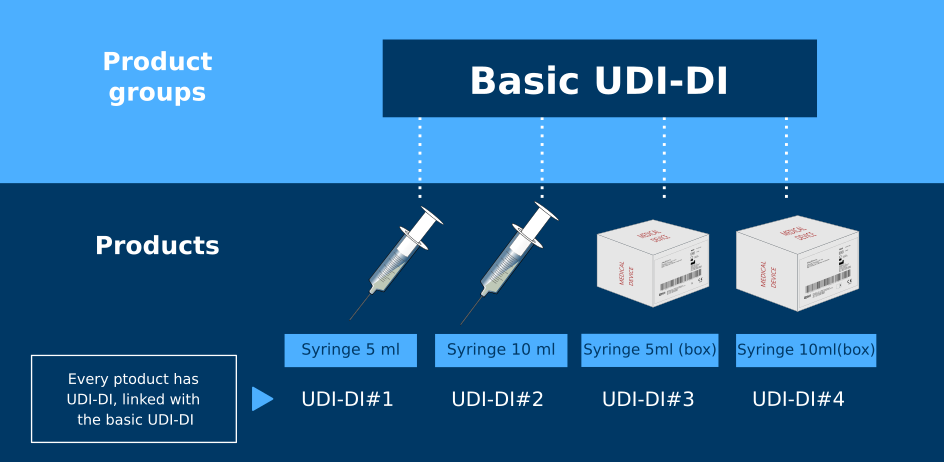
One Basic UDI-DI can connect several UDI-DIs
The retained illustration shows the hierarchy correctly at a high level. The manufacturer still has to justify that every included device remains inside the regulatory grouping criteria.
Same intended purpose
The devices perform the same medical purpose defined by the manufacturer.
Same risk class
The grouping cannot cross MDR or IVDR risk classes.
Essential design characteristics
Differences must not alter the essential design identity of the model group.
Essential manufacturing characteristics
Manufacturing differences must remain compatible with one coherent model definition.
Similar appearance, a shared brand name or a common catalogue series is not enough by itself. The grouping must be defensible against all four criteria.
Coded structure
How a GS1 Basic UDI-DI is assembled
GS1 calls its Basic UDI-DI the Global Model Number or GMN. The structure below replaces the former image and is specific to GS1. HIBCC, ICCBBA and IFA use their own formats and rules.
GS1 GMN structure
GS1 company prefix
Identifies the organisation within the GS1 system. Its length depends on the prefix licensed to the company.
Model reference
An alphanumeric reference chosen and controlled by the manufacturer to identify the permitted Basic UDI-DI model group.
Check-character pair
Two mandatory characters generated according to the GS1 calculation method to verify the completed GMN.
The company prefix and model reference together can contain up to 23 characters. The two mandatory check characters are then added.
The Basic UDI-DI is not a GTIN and should not be created by copying a product or package UDI-DI. Follow the current specification and validation tools of the selected issuing entity.
Assignment workflow
Assign the identifier after the model boundaries are controlled
The manufacturer assigns the Basic UDI-DI under the rules of one designated issuing entity. The issuing entity supplies the coding system and company-specific credentials. It does not decide which products may be grouped together.
Define the model group
Map intended purpose, classification, design and manufacturing characteristics.
Select an issuing entity
Choose GS1, HIBCC, ICCBBA or IFA and obtain the required company credentials.
Create and verify the identifier
Apply the selected entity's current syntax, calculation and validation rules.
Link every UDI-DI
Maintain an unambiguous relationship between the Basic UDI-DI and each device or package UDI-DI.
Synchronise records
Use the same controlled identifier in EUDAMED, declarations, certificates and technical documentation.
Designated issuing entities
Choose one system and follow its rules consistently
The European Commission has designated four issuing entities for MDR and IVDR UDI assignment. Their designations were renewed in 2024. Formats are not interchangeable, even though they serve the same EU function.
GS1
Uses the Global Model Number as its Basic UDI-DI structure.
HIBCC
Provides the HIBC coding system for device and model identification.
ICCBBA
Provides the ISBT 128 system, particularly for medical products of human origin.
IFA GmbH
Provides the IFA coding system and its Basic UDI-DI format.
Regulatory use
One identifier must remain consistent across the dossier
The Basic UDI-DI is a cross-document control point. A mismatch can obscure which products were assessed, certified, declared and registered.
UDI and Devices records
Main key connecting the model group to its registered device data and UDI-DIs.
EU declaration of conformity
Required in the declaration for devices covered by the Basic UDI-DI.
Relevant notified-body certificates
Used to identify the devices covered by applicable product-assessment certificates.
Technical documentation
Connects device identity, configurations, evidence and certificate scope.
Safety or performance summaries
Referenced in SSCP or SSP documentation where those summaries are required.
Certificate of free sale
May identify the covered device through its Basic UDI-DI under the applicable Regulation.
Change control
Test the grouping separately from the UDI-DI change rules
A new UDI-DI does not automatically create a new Basic UDI-DI. The first question is whether the changed device still belongs to the same permitted model group.
Product or label data changes
Assess the applicable UDI-DI trigger under Annex VI and the issuing-entity rules.
Do the four model criteria still align?
Recheck intended purpose, risk class, essential design and essential manufacturing characteristics.
Retain or assign a new Basic UDI-DI
Document the decision and update every affected regulatory record consistently.
A UDI-DI can be associated with one and only one Basic UDI-DI. Several UDI-DIs may sit under that Basic UDI-DI when the grouping remains valid.
Current EUDAMED position
The UDI and Devices module is now mandatory
The European Commission declared the module functional in November 2025. Use of the UDI and Devices module became mandatory on 28 May 2026. Manufacturers should control Basic UDI-DI assignment and the related data set before registration, not create the identifier during data entry.
Review EUDAMED registrationOfficial sources
Apply the Regulation and the selected issuing-entity rules together
The Regulations establish the legal framework. Non-binding MDCG guidance explains the common administrative interpretation, while each issuing entity controls the syntax and technical rules of its own identifier system.
Regulation (EU) 2017/745
MDR Article 27, Article 29 and Annex VI
Regulation (EU) 2017/746
IVDR Article 24, Article 26 and Annex VI
MDCG 2018-1 Rev.4
Basic UDI-DI concept, documentation and UDI-DI change triggers
European Commission UDI page
Issuing entities, guidance and current implementation resources
EUDAMED UDI and Devices registration
Current module status, data sets and registration guidance
GS1 GMN structure
Company prefix, model reference and check-character pair
Frequently asked questions
Basic UDI-DI in practice
Most implementation errors begin by treating the Basic UDI-DI as a label code or by defining the model group too broadly.
Is the Basic UDI-DI printed on the label?
No. It is independent of packaging and labelling and does not appear on a trade item. The label carries the applicable UDI-DI and UDI-PI.
Who assigns the Basic UDI-DI?
The manufacturer assigns it using the system and rules of a designated issuing entity. The issuing entity supplies the standard and company credentials but does not determine the manufacturer's device grouping.
Can all products from one manufacturer share one Basic UDI-DI?
No. The devices must share the same intended purpose, risk class and essential design and manufacturing characteristics. Brand or catalogue structure alone does not establish a compliant group.
Does every new UDI-DI require a new Basic UDI-DI?
Not necessarily. Multiple UDI-DIs may be linked to one Basic UDI-DI. A new Basic UDI-DI is required when the devices can no longer remain within the same permitted model group.
Can one UDI-DI belong to two Basic UDI-DIs?
No. MDCG 2018-1 Rev.4 states that a UDI-DI is associated with one and only one Basic UDI-DI.
Is EUDAMED UDI registration mandatory?
The UDI and Devices module became mandatory to use on 28 May 2026. The precise route and data requirements depend on the device and its regulatory status, including the separate rules for legacy devices.
From product architecture to registration
Build a Basic UDI-DI structure that remains traceable
MDRC can review product grouping, map Basic UDI-DIs to device and packaging UDI-DIs, define change controls and prepare consistent records for EUDAMED, technical documentation and certification.
Discuss your UDI structure